
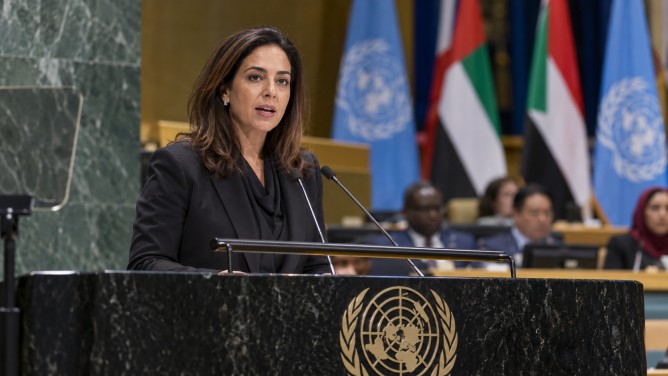
The nomination of Lana Nusseibeh, a diplomat from the United Arab Emirates, for the position of United Nations Secretary-General has sparked criticism from Sudanese diaspora communities and international human rights organizations. Critics are concerned about her previous defense of the UAE against allegations of supporting Sudan’s paramilitary Rapid Support Forces (RSF), which raises questions about her independence and suitability for the role.
The controversy comes as the UAE has nominated Nusseibeh to succeed António Guterres, the current UN Secretary-General, whose term ends this year. This move has been contentious due to ongoing allegations that the UAE has provided support to the RSF. The RSF has been accused of committing atrocities against civilians, including an attack on El Fasher in October 2025, described by the United Nations as having characteristics associated with genocide.
Hala al-Karib, a Sudanese women’s rights and pro-democracy activist, has expressed concerns about Nusseibeh’s ability to act independently of her government’s stance on Sudan. Al-Karib warned that approving her nomination could undermine efforts to secure justice for victims of atrocities in the country. Similar sentiments have been echoed by other Sudanese activists, who fear that her appointment could weaken public confidence in the United Nations.
Human rights advocates emphasize the importance of the UN maintaining its independence and holding powerful governments accountable. Kenneth Roth, former executive director of Human Rights Watch, criticized Nusseibeh for her past responses to allegations of UAE support for the RSF, suggesting that her stance raises concerns about her approach to accountability.
Nusseibeh has defended her candidacy by condemning the RSF’s actions in Sudan and pledging support for UN fact-finding missions and efforts to promote accountability and transitional justice if appointed. She has also taken leave from her ministerial position in the UAE government to reflect the independence required of a UN Secretary-General.
The selection process for the next UN Secretary-General is competitive, requiring a candidate to secure at least nine affirmative votes in the 15-member UN Security Council and avoid a veto from any of its five permanent members: the United States, the United Kingdom, China, France, and Russia. The nomination of Nusseibeh adds further uncertainty to the race, with former Costa Rican vice-president Rebeca Grynspan previously emerging as a leading candidate in an informal poll.
This controversy highlights broader concerns about the independence of international institutions and their ability to ensure accountability for alleged human rights violations in conflicts. The outcome of Nusseibeh’s nomination will be closely watched as it may have significant implications for the UN’s role in promoting justice and accountability on the global stage.